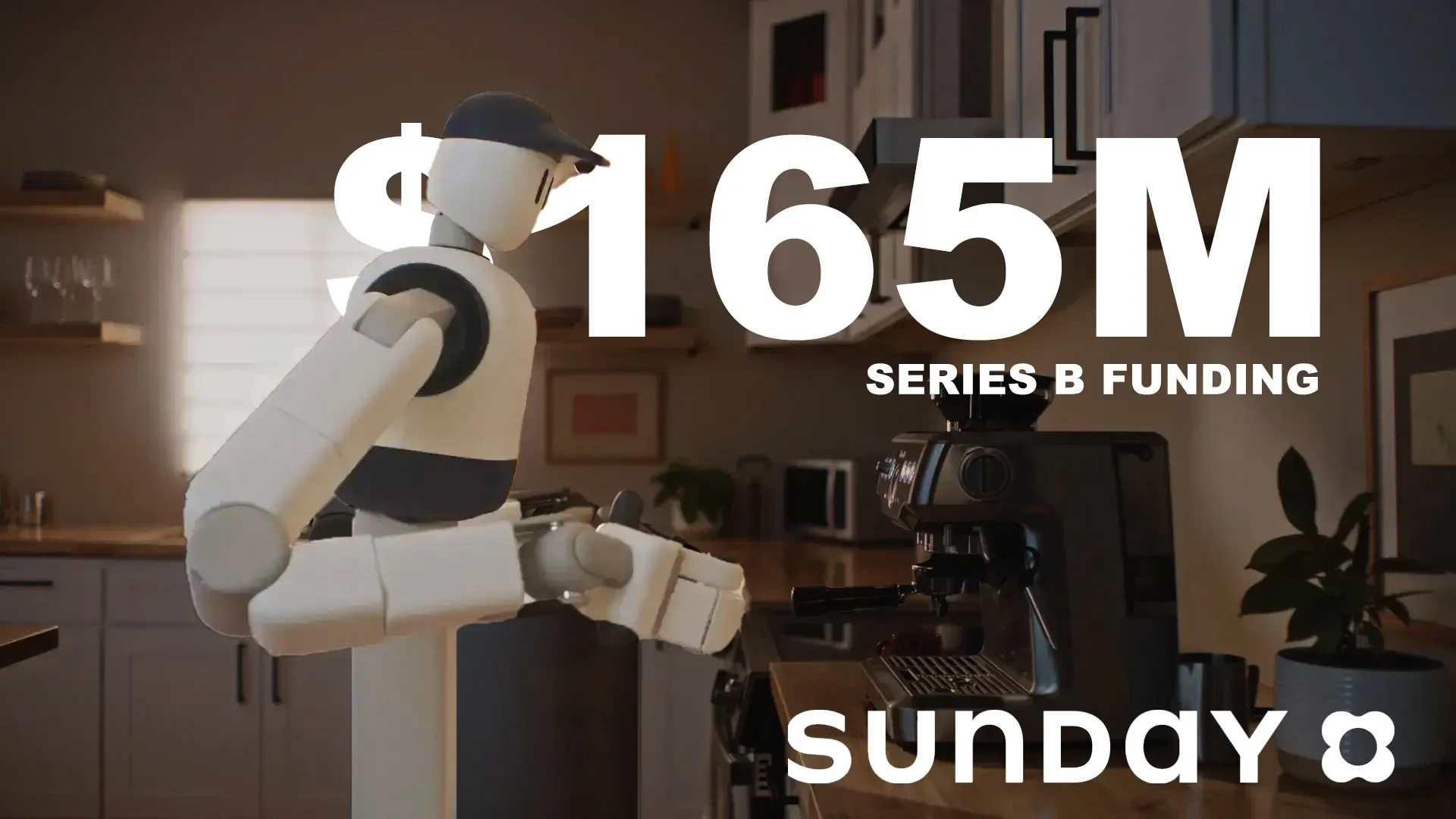
- Sunday secured $165 million in Series B funding, achieving a $1.15 billion valuation.
- The capital is dedicated to moving from R&D to the real-world deployment of Memo, a purpose-built domestic robot.
- The company’s "moat" is its Skill Capture Glove system, which uses real-world data from over 500 households to train AI models, bypassing the limitations of lab-based simulations.
- Founded by AI researchers Tony Zhao and Cheng Chi, the team combines expertise from industry giants like Tesla, OpenAI, and DeepMind
The robotics industry has officially entered a new phase of maturity. On March 12, 2026, Sunday Robotics, the AI startup dedicated to personal household robotics, announced it has secured an oversubscribed $165 million Series B funding round, propelling the company to a $1.15 billion valuation.
This milestone marks a critical pivot for the company. Led by Coatue Management, with participation from a heavy-hitting consortium including Bain Capital Ventures, Fidelity, Tiger Global, Benchmark, and Conviction, this round signals that investors are shifting their focus from "demonstration-ready" prototypes to "deployment-ready" infrastructure. With this influx of capital, Sunday has declared it will move past the era of viral demos, focusing its resources entirely on the real-world deployment of its household robot, Memo, with beta deliveries slated for late 2026.
Inside the Investment: Solving the "Data Bottleneck"
While the robotics sector has seen a flurry of capital, investors in Sunday’s Series B are specifically betting on the company's unique approach to the "data moat."
"We raised our Series B to stop giving demos. Now, we're focusing entirely on deployment, with Beta deliveries starting in just months." - Tony Zhao, CEO of Sunday
For years, the industry has struggled with a fundamental bottleneck: high-quality data. Sunday’s competitive edge lies in its vertically integrated data pipeline. Unlike competitors who rely on expensive, controlled-environment teleoperation, Sunday has developed a low-cost (~$400) "Skill Capture Glove" system. This allows a distributed network of "Memory Developers" to record everyday tasks in their own actual homes.
By owning the full stack, from hardware design and manufacturing to this proprietary data-capture pipeline, Sunday can iterate on its models at industry-leading speeds. As Thomas Laffont, co-founder of Coatue, noted, the company's "velocity is the best signal we have that they will be the first to ship truly helpful, autonomous home robots at scale."
Company Background: Built by Researchers, Forged by Data
Sunday Robotics was founded in 2025 by two of the most influential figures in modern embodied AI: Tony Zhao (CEO) and Cheng Chi (CTO).
The founders first connected on X (formerly Twitter) after publishing landmark research papers just a month apart. Zhao’s work on ALOHA—a low-cost imitation learning system—and his development of Action Chunking with Transformers (ACT), coupled with Chi’s research on Diffusion Policy and the UMI (Universal Manipulation Interface), essentially redefined how the field approaches robot learning.
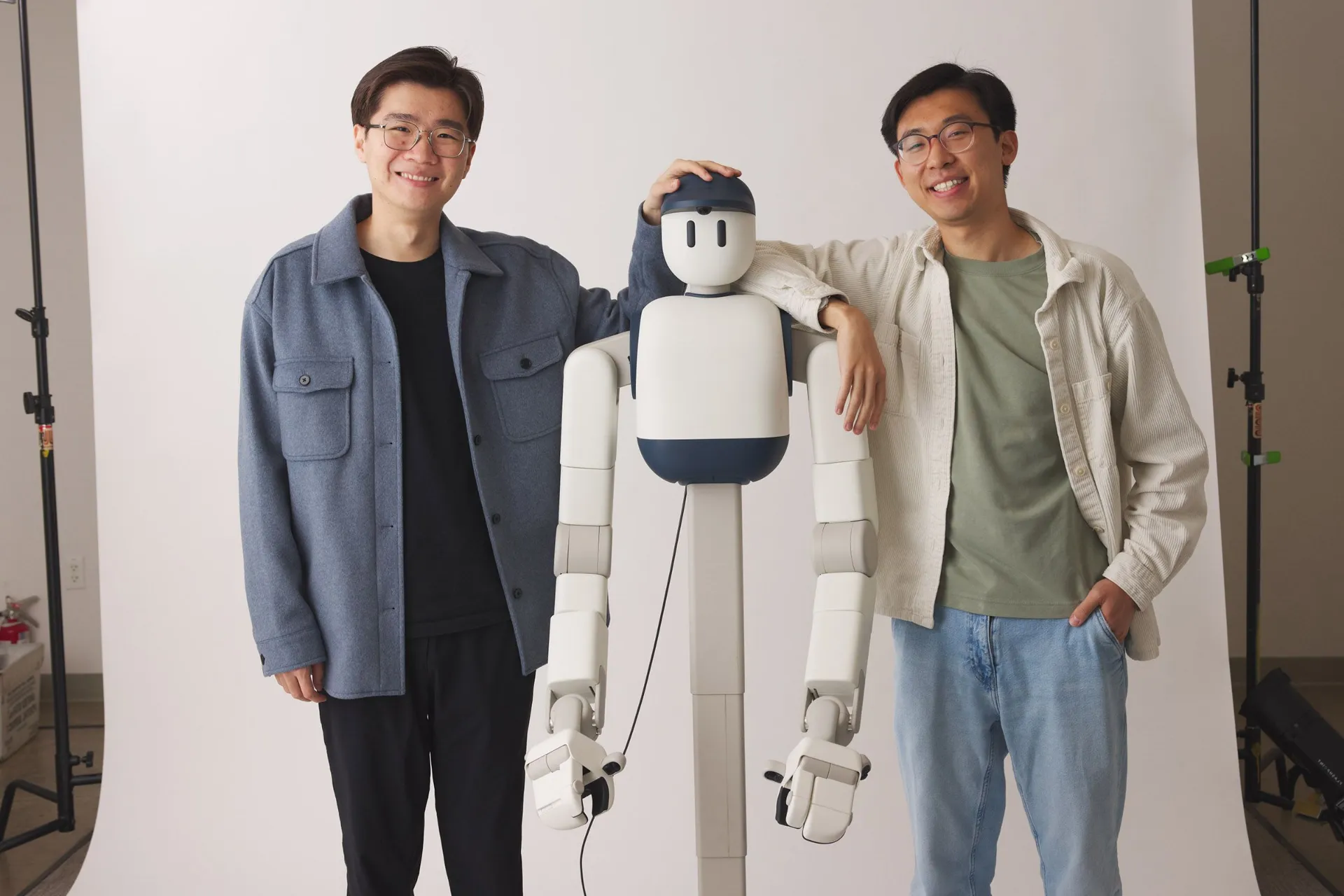
Recognizing that the "GPT moment" for robotics required moving away from laboratory-bound teleoperation, they founded Sunday with a radical philosophy: radical simplification. Their flagship robot, Memo, features a functionalist, non-humanoid design optimized for safety, reliability, and cost-efficiency. By prioritizing robustness over feature breadth, Sunday aims to deliver a robot that can handle the "messy" reality of domestic life such as laundry, dishes, and clutter, at a price point (targeting under $10k) that makes household autonomy a reality rather than a science experiment.
The Memo Platform: Purpose and Development
At the heart of the company’s mission is Memo, a general-purpose household robot designed to act as an "ever-learning" domestic appliance.
- Core Purpose:
Memo is built to handle the "messy reality" of domestic life, specifically high-frequency, repetitive tasks such as clearing dining tables, loading and unloading dishwashers, folding laundry (including delicate or deformable items like socks), and even preparing simple items like espresso. By automating these "long-horizon" tasks, the platform aims to give households back time rather than adding another screen or notification to their day. - Design Philosophy:
Unlike bipedal humanoids that struggle with balance and power efficiency, Memo utilizes a "utility-first" approach. It features a wheeled, rolling base for passive stability and a telescoping "Z-axis" spine, allowing it to reach from floor level to high shelves (up to 2.1 meters) without the complexity of balancing. It is clad in a soft, silicone-like shell designed to be safe, approachable, and easily cleaned in family environments. - Stage of Development:
The project is currently in the pre-commercial prototype phase. Sunday is currently moving from internal R&D toward its "Founding Family" beta program. Late in 2026, 50 selected households will receive uniquely numbered beta units to help the company iterate on real-world reliability, safety, and service before a broader commercial rollout.
The Road Ahead
With over 70 engineers and researchers—many of whom are veterans from Tesla, DeepMind, Waymo, OpenAI, Meta, and Apple—Sunday is no longer an academic exercise. The company is currently scaling its data operations by 5x this year to feed the "Retail AI Brain" that powers Memo. As they move toward their Thanksgiving 2026 launch, the industry will be watching closely to see if they can finally bridge the gap between impressive research and the autonomous, helpful robot in every home.
About the author