
Enquire about Robot

Simply fill up the form, our team will then reach out to you to connect to the relevant parties who can help facilitate your request.

Brand & Model
Fields marked * are required. Refer to our privacy policy for questions.
Thank you! Your submission has been received!
Oops! Something went wrong while submitting the form.
HomeRobots

Barkour

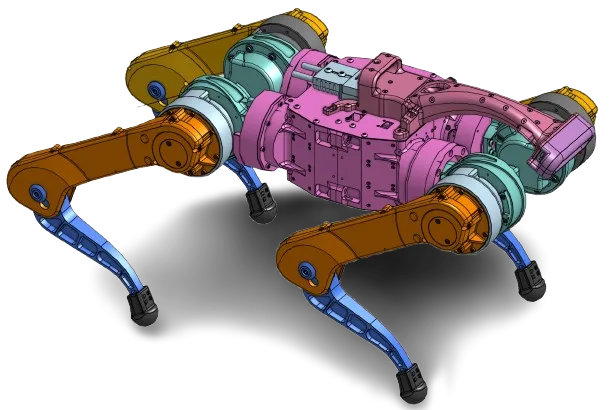
Research quadruped from Google DeepMind, about 14 kg, with published design files, built to benchmark legged agility on an obstacle course modelled on dog agility (2023).
Software Type
Open Source
Software Package
Pigweed-based motor driver firmware, host-side EtherCAT motor control example, MuJoCo and MJX simulation models (software under Apache 2.0)
Aparobot Readiness Score
ARS?
0
...
Actuators
Modified T-Motor AK80-9 motors with custom motor drivers; 3 Dynamixel XH430-W350T motors in the actuated head
Compute
Intel NUC11TNBv7 (Core i7-1185G7, 64 GB RAM, 2 TB SSD)
Sensors
Intel RealSense D435i and OAK camera (static head) or two OAK cameras (actuated head); 3DMCV7-AHRS torso IMU; 12 IMUs in the motor drivers
Max Op. time
mins

Recent Robot Videos

*Aparobot claims no ownership of videos posted unless otherwise stated.
Description text
Date

Robot Brief

Barkour is a research quadruped robot developed by Google DeepMind, and also the name of a benchmark for measuring legged robot agility. The benchmark is an obstacle course modelled on dog agility competitions, with weave poles, an A-frame, a broad jump and a pause table set in a 5 m by 5 m area.

Google DeepMind published the benchmark and its learned locomotion controllers in May 2023 and later released the robot's design files, firmware and simulation models on GitHub, with the hardware files under a non-commercial licence. The robot has no commercial version.

Use Cases

  • Agility benchmarking: Runs a timed obstacle course scored from 0 to 1 against the pace of small dogs.
  • Dynamic locomotion: Walks, turns, climbs an A-frame and jumps using learned controllers.
  • Fall recovery: Uses a recovery policy to stand up after a fall and continue the course.
  • Open research platform: Design files, firmware and MuJoCo models are published for other researchers.

Industries

  • Robotics research: Platform for developing and comparing legged locomotion controllers.
  • Simulation and machine learning: MuJoCo and MJX models support training controllers in simulation before transfer to the robot.

Specifications

Length
-
mm
Width
-
mm
Height (ResT)
-
mm
Height (Stand)
-
mm
Height (Min)
-
mm
Height (Max)
-
mm
Weight (With Batt.)
-
14
kg
Weight (NO Batt.)
-
kg
Max Step Height
-
mm
Max Slope
+/-
-
°
Op. Temp (min)
-
°C
Op. Temp (Max)
-
°C
Ingress Rating
-
No items found.

Intro

Barkour is a custom-built quadruped with four legs and twelve motor drivers. For the version released on GitHub, Google DeepMind lists a weight of about 14 kg, modified T-Motor AK80-9 motors with 9 Nm nominal and at least 18 Nm peak joint torque and at least 25 rad/s peak joint velocity, an EtherCAT bus typically running at 1 kHz, an onboard Intel NUC11TNBv7 computer and a 60 V lithium-ion battery of about 122 Wh. It comes with a fixed head (Intel RealSense D435i and one OAK camera) or an actuated head with a mouth-like gripper and two OAK cameras.

The robot described in the May 2023 paper was an earlier build of 11.5 kg with T-Motor AK80-6 actuators (12 Nm peak) and control from an off-board workstation. In that paper the robot's best run scored 0.91 and took 20.4 s, about twice the time of a small dog, with a peak speed of 2.3 m/s during the jump. The team reports about 3,600 course attempts across two robots.

Google DeepMind released the hardware design, motor driver firmware based on Pigweed, and MuJoCo simulation models on GitHub, with software under the Apache 2.0 licence and other materials under CC BY-NC 4.0; the repository states it is not an official Google product. Battery runtime, dimensions and the number of robots built have not been published, and there is no commercial version.

Connectivity

  • EtherCAT bus to the motor drivers (typically 1 kHz)
  • Wi-Fi 6 (Intel AX201) and Bluetooth 5.1
  • 2 x USB-C (USB4/Thunderbolt)
  • 2.5 Gb/s Ethernet via M12 connector
  • Wireless emergency stop, range at least 50 m

Capabilities

  • Joint torque: 9 Nm nominal and at least 18 Nm peak per joint.
  • Joint speed: Peak joint velocity of at least 25 rad/s.
  • Real-time control: EtherCAT bus typically at 1 kHz.
  • Head options: Fixed camera head, or actuated head with a gripper.
  • Safety: Wireless emergency stop with a range of at least 50 m.