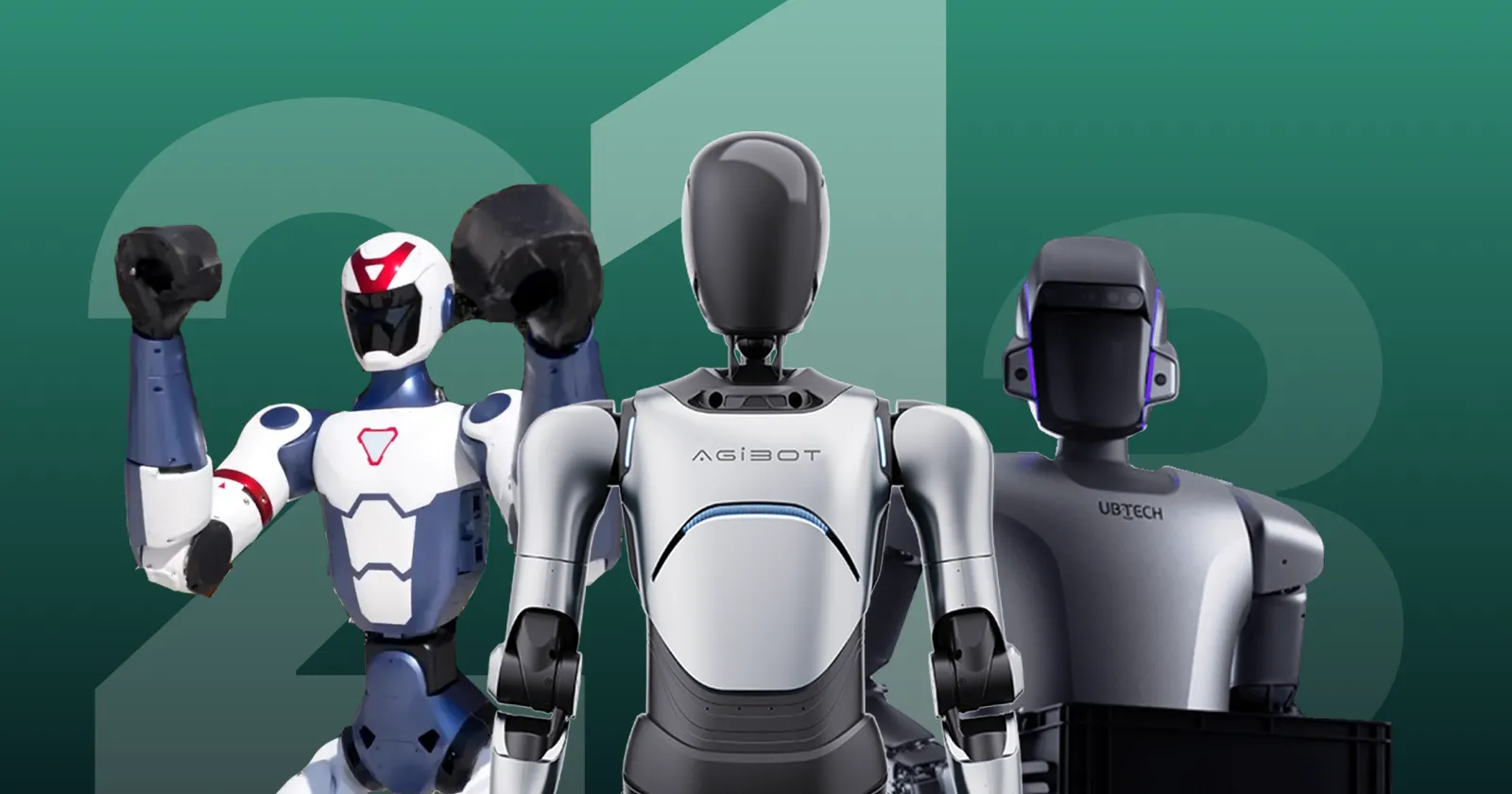
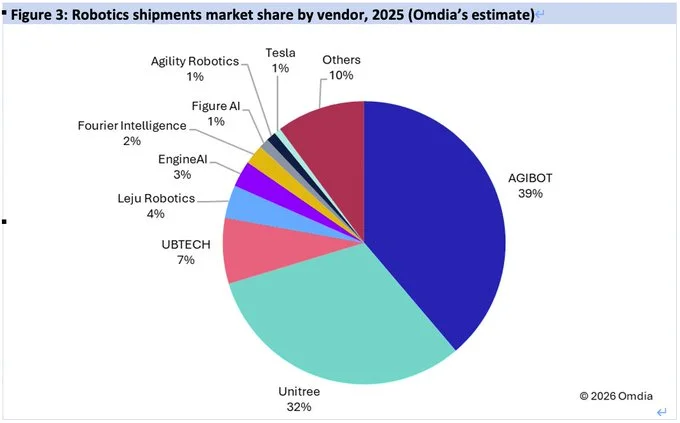
- Top Dog: Zhiyuan Innovation (Agibot) is #1 globally with ~5,168 units shipped (39% market share).
- The Chasers: Unitree takes 2nd place (32%), followed by Ubtech (7%).
- Market Size: Global shipments hit ~13,000 in 2025 (a 400% increase YoY).
- Price War: Chinese models ($6k-$14k) are significantly cheaper than Western counterparts ($20k+), driving adoption.
- Business Outlook for 2026-2027: Best for industrial/logistics early adopters.
- Business Outlook for 2028-2030: Rapid expansion into service and commercial sectors expected.
- Future Forecast: Global shipments projected to hit 2.6 million units by 2035.
2026: The Year Robots Officially Left the Sci-Fi Section
If you were waiting for the moment when robots would finally walk among us without falling over every five seconds, congratulations—you made it.
We are officially in 2026, and according to the latest number-crunching from the folks at Omdia (specifically their fresh-off-the-press "General-Purpose Embodied Intelligent Robot 2026" report), the robot revolution isn't coming; it’s already clocked in for its shift. But here is the plot twist: the robots leading the charge aren't coming from a secret lab in Silicon Valley. They are shipping out of Shanghai and Hangzhou.
Let’s dive into the nuts, bolts, and silicon of the humanoid robotics market, dissect who is winning the race, and answer the billion-dollar question for every business owner out there: Is it finally time to hire a droid?
The Scoreboard: China Takes Gold, Silver, and... well, most of the Pie
Remember when we thought 2025 was just going to be another year of "prototype teasing"? Well, the industry apparently didn't get the memo. Global shipments of humanoid robots quadrupled last year, hitting roughly 13,000 units. That might sound small compared to iPhone sales, but in the world of bipedal machines that can carry boxes, it is a massive leap.
According to Omdia, the global leaderboard for 2025 looks like this:
- The Champion: Zhiyuan Innovation (Agibot)
Shipments: ~5,168 units
Market Share: 39%
The Vibe: The undisputed heavyweight. Agibot (known as Zhiyuan in China) isn't just showing off cool videos; they are shipping hardware. Their CEO, the legendary "Iron Man" Peng Zhihui, has steered the company to mass production while others are still fine-tuning their walking algorithms. Even NVIDIA’s Jensen Huang gave them a shoutout at CES this week, which is basically the tech equivalent of being knighted. - The Runner-Up: Unitree Robotics
Shipments: ~4,200 units
Market Share: 32%
The Vibe: If Agibot is the disciplined industrial worker, Unitree is the agile gymnast. Famous for their backflipping dogs, they have pivoted hard to humanoids. They are snapping at Agibot’s heels with impressive volume, largely thanks to their aggressive pricing strategies. - The Veteran: Ubtech Robotics
Shipments: ~1,000 units
Market Share: 7%
The Vibe: The steady hand. They have been in the game longer than most and are finding their groove in industrial applications, though they have lost the volume war to the newer, faster entrants.
Combined, these three Chinese companies control nearly 80% of the global market. Omdia’s heatmap analysis gave Agibot the highest "Advanced" rating in six out of eight categories, including payload capacity and AI learning ability. In short: these aren't toys; they are tools.
The "China Speed" Factor: Why Is the West Lagging?
You might be asking, "Where is Tesla? Where is Boston Dynamics?"
They are there, but they are playing a different game. While Western companies are focusing on perfecting the software brain (which is arguably smarter), Chinese manufacturers have mastered the art of scaling hardware.
It comes down to two words: Price Tag.
- Unitree is selling an entry-level humanoid for roughly $6,000. That is cheaper than a used Honda Civic.
- Agibot (Zhiyuan) offers a streamlined version for around $14,000.
- Tesla Optimus? Elon Musk is targeting a price range of $20,000 to $30,000, but mass production is still in the "ramp-up" phase (a.k.a. production hell).
Omdia notes that China’s supply chain dominance allows them to churn out motors, actuators, and sensors at a fraction of the cost. When you can build a robot for the price of a vending machine, businesses are much more willing to buy five of them just to see what happens.
Business Feasibility Assessment (2026-2030)
Feasibility Verdict: High for Industrial / Low for Service.
Who should buy? Large-scale manufacturing and logistics centers (automotive, warehousing).
Why? The current generation of robots excels at "structured" tasks—moving a box from Point A to Point B. They don't get tired, they don't need coffee breaks, and they don't complain about the playlist.
Risk: ROI is still being proven. Buying now means you are an "early adopter," which is code for "unpaid beta tester." Expect bugs.
The Medium Term (2028-2030): The "Commercial" Era
Feasibility Verdict: Moderate to High for Service Sectors.
The Shift: As AI models improve (thanks to the "ChatGPT moment for physical AI" Jensen Huang discussed), robots will get better at handling "unstructured" environments.
New Scenarios: You will see them in retail restocking shelves, security patrols (Agibot is already doing this), and perhaps hazardous healthcare tasks (handling bio-waste).
Growth Forecast: Omdia predicts shipments will skyrocket to 2.6 million units by 2035. The curve between 2028 and 2030 is where the hockey stick growth happens.
The Cautionary Tale: The "Bubble" Risk
It’s not all sunshine and servos. The Chinese government recently issued warnings about a "bubble" forming, with over 150 companies rushing into the space. Many of these products are homogenous (copy-cats).
Business Tip: If you buy a robot, stick to the "Tier 1" rated companies (Agibot, Unitree, Tesla, Figure). Avoid the cheap knockoffs that might stop receiving software updates by next Tuesday.
Our Final Take
The Omdia 2026 report is a wake-up call. The hardware is ready, the prices are dropping, and the AI brains are getting sharper by the day. 2025 was the year China proved it could build the bodies faster than anyone else. 2026 will be the year we find out if the brains can keep up with the real world.
For now, Zhiyuan (Agibot) is wearing the yellow jersey, but in a marathon this long, you never count out the competition—especially when one of them owns a rocket company.
About the author