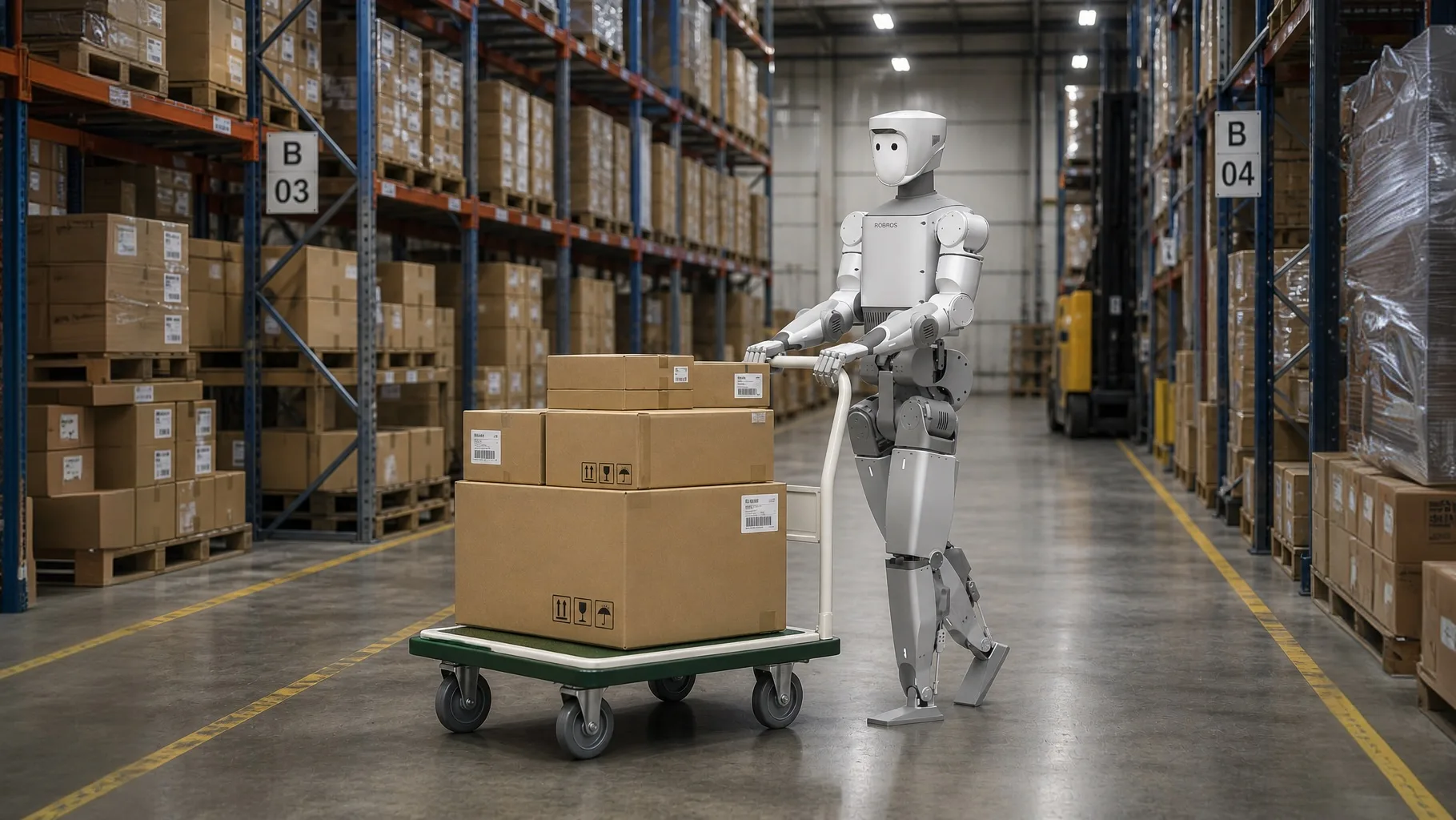
- Exemption approved 13 October 2026 by Korea's regulatory special exemption committee
- 20 ROBROS humanoids at Nepes, Sungwoo Hitech, HD Hyundai Samho and Delivery Lab
- Lifts the fence requirement for trials, subject to risk assessment and added safety standards
- Robot model, start date and exemption length not published
- Government plans KRW 2.3 trillion humanoid investment by 2030 and 1,080 government humanoid purchases
South Korea's industry ministry has cleared robot maker ROBROS to put 20 humanoid robots to work alongside staff at four companies, according to a ministry release of 13 October 2026. The approval came from the ministry's Industrial Convergence Regulatory Special Exemption Committee at its sixth meeting of the year. The robots will run field demonstrations at chipmaker Nepes, car parts maker Sungwoo Hitech, shipbuilder HD Hyundai Samho and cold-chain logistics firm Delivery Lab. Korean safety rules assume industrial robots are fixed in place and fenced off, which until now kept mobile humanoids out of spaces shared with workers.
Why it matters
The approval gives humanoids a named legal route onto Korean factory floors shared with people.
The tasks are specific. At Nepes the robots will remove contaminants from circular parts used in semiconductor back-end packaging. At Sungwoo Hitech they will place car body parts in set positions. At HD Hyundai Samho they will stack the small pieces that secure scaffolding to a ship's hull. At Delivery Lab they will move chilled logistics packaging, according to eToday and Seoul Economic Daily.
What is proven is the approval itself. What is not yet known is quite a lot: the ministry did not name the ROBROS model, give the length of the exemption, publish a start date or list the safety conditions beyond risk assessments and supplemented safety standards. Seoul Economic Daily reports that data from the trials will be used to write future safety standards.
The policy context explains the speed. The government plans to invest a cumulative KRW 2.3 trillion in the humanoid sector by 2030, raise the domestic share of core components to 80% and buy a cumulative 1,080 Korean-made humanoids, according to Seoul Economic Daily. The same report cites International Federation of Robotics figures of 30,200 new industrial robots installed in Korea in 2025, against 354,200 in China.
The same committee also approved, for the first time, a four-legged patrol robot from MaumAI on riverside paths and in parks in Cheonan, with AI hazard detection and live video to a control centre.
For buyers outside Korea, the useful point is the template: a named vendor, named sites, named tasks and a data-gathering trial before rules are fixed. Regulators elsewhere face the same question.
Use cases touched: manufacturing and logistics.
Why factory robots are fenced, and what collaborative operation means
Most industrial robot arms work inside guarded cells because they are fast, strong and do not know a person is there. The international safety standard for industrial robots, ISO 10218 in two parts, was built around that model, and its 2011 edition gave only a few pages to robots working with people, according to A3, the US automation association.
ISO/TS 15066, a technical specification announced by ISO in 2016, added detail. It defines four ways a robot and a person can share space: a safety-rated monitored stop, where the robot halts when someone enters; hand guiding, where the person moves the robot directly; speed and separation monitoring, where the robot slows or stops to keep a minimum distance; and power and force limiting, where contact is allowed but kept below set limits. Those limits come from a pain study of 100 people covering 29 body areas.
Take a humanoid carrying a chilled box past a worker at a logistics site. Under speed and separation monitoring it would slow as the worker approached and stop inside a set distance. Under power and force limiting it could brush past, but only with forces below the limit for the body part it might touch. A walking robot adds one more question for the risk assessment: what happens if it falls. Which of these methods ROBROS will use has not been published.
Key facts at a glance
DecisionSpecial exemption for field demonstrationApproved byIndustrial Convergence Regulatory Special Exemption Committee, 6th meeting of 2026Date13 October 2026Robot makerROBROSUnits20 humanoid robotsSitesNepes, Sungwoo Hitech, HD Hyundai Samho, Delivery LabRobot modelNot namedDuration and start dateNot published
ROBROS's profile on Aparobot: ROBROS. The ministry did not name the model, so this article is not linked to a specific robot record.
Questions to ask the vendor
- Which ROBROS model is being deployed, and is it the same unit sold commercially?
- Which collaborative safety method does it use, and has it been assessed against ISO 10218 or ISO/TS 15066?
- How long does the exemption run, and what results must be shown for the robots to stay after it ends?
- What happens if the robot falls in a shared aisle, and who carries the liability during the trial?
Sources
- Ministry of Trade and Industry, Korea, press release on the 6th 2026 Industrial Convergence Regulatory Special Exemption Committee, 13 October 2026 (Korean)
- Seoul Economic Daily, Korea Clears Safety Rules to Put 20 Humanoid Robots on Factory Floors, 14 October 2026
- Financial News, 13 October 2026 (Korean)
- eToday, 13 October 2026 (Korean)
- A3, ISO/TS 15066 Explained
- ISO, Robots and humans can work together with new ISO guidance, 2016
About the author

