


Intro
AeiRobot Co., Ltd. was founded in 2018 in Ansan, South Korea, as a technology spin-off from the robotics laboratory of Professor Jaekweon Han of the Department of Robotics Engineering at Hanyang University ERICA (HERoEHS). The company is led by CEO Yunseol Um (Eum YounSeal), who also serves on the executive committee of the South Korean government-backed K-Humanoid Alliance, actively shaping the country's national strategy for humanoid robotics. From its origins in academic research, AeiRobot was purpose-built to commercialise humanoid robot technologies that can operate directly alongside people in labour-intensive industrial environments. Its founding philosophy, expressed as "A Robot for All," reflects an intent to build humanoid platforms that move and interact like people, enabling deployment in existing workspaces without facility modifications.
The company's core technical differentiation lies in its proprietary gearless linear actuator system, developed entirely in-house. Unlike conventional robot joints that rely on rotary motors paired with reduction gearboxes, AeiRobot's linear actuators achieve force-based control through current-sensitive, back-drivable mechanisms with low reduction ratios. This results in quieter operation, lower inertia, higher energy efficiency, and more natural physical interaction with humans. The company reached its third-generation linear actuator design by the time of its Series A round in 2025, with each iteration delivering improved performance at lower manufacturing cost, a key factor in AeiRobot's stated aim to bring affordable humanoids to mass production. On the software side, AeiRobot integrates NVIDIA Isaac GR00T, a full-body humanoid control AI platform, alongside its own AI-based autonomous systems for perception, natural language processing, and context-aware gesture control.
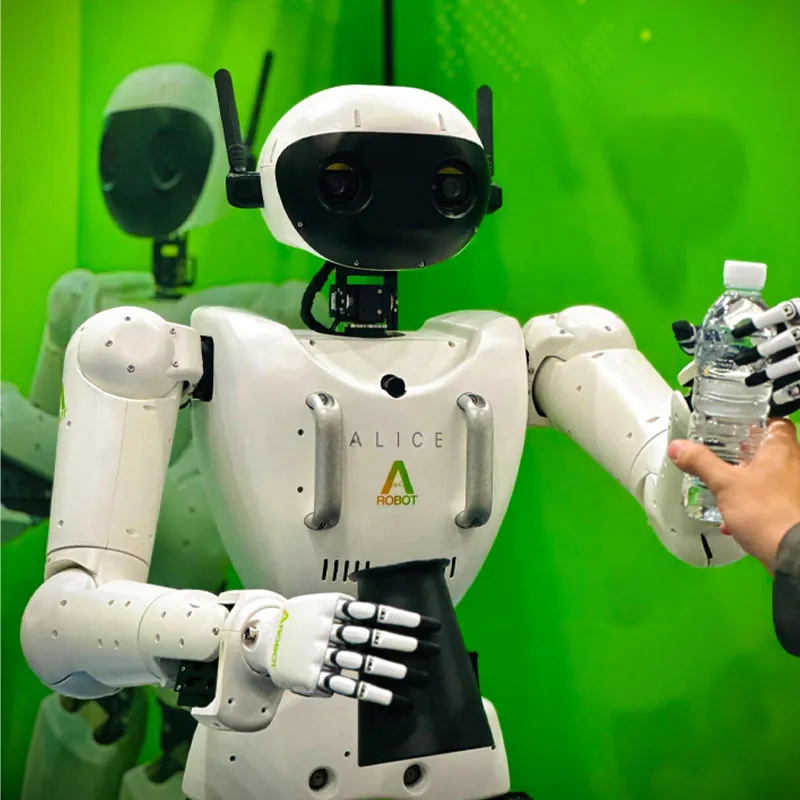
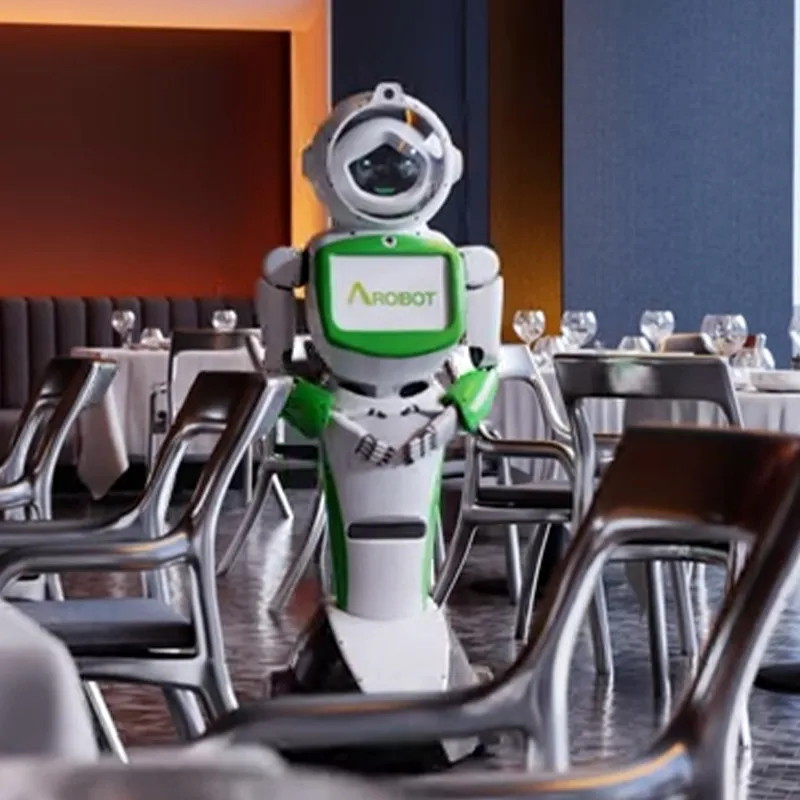
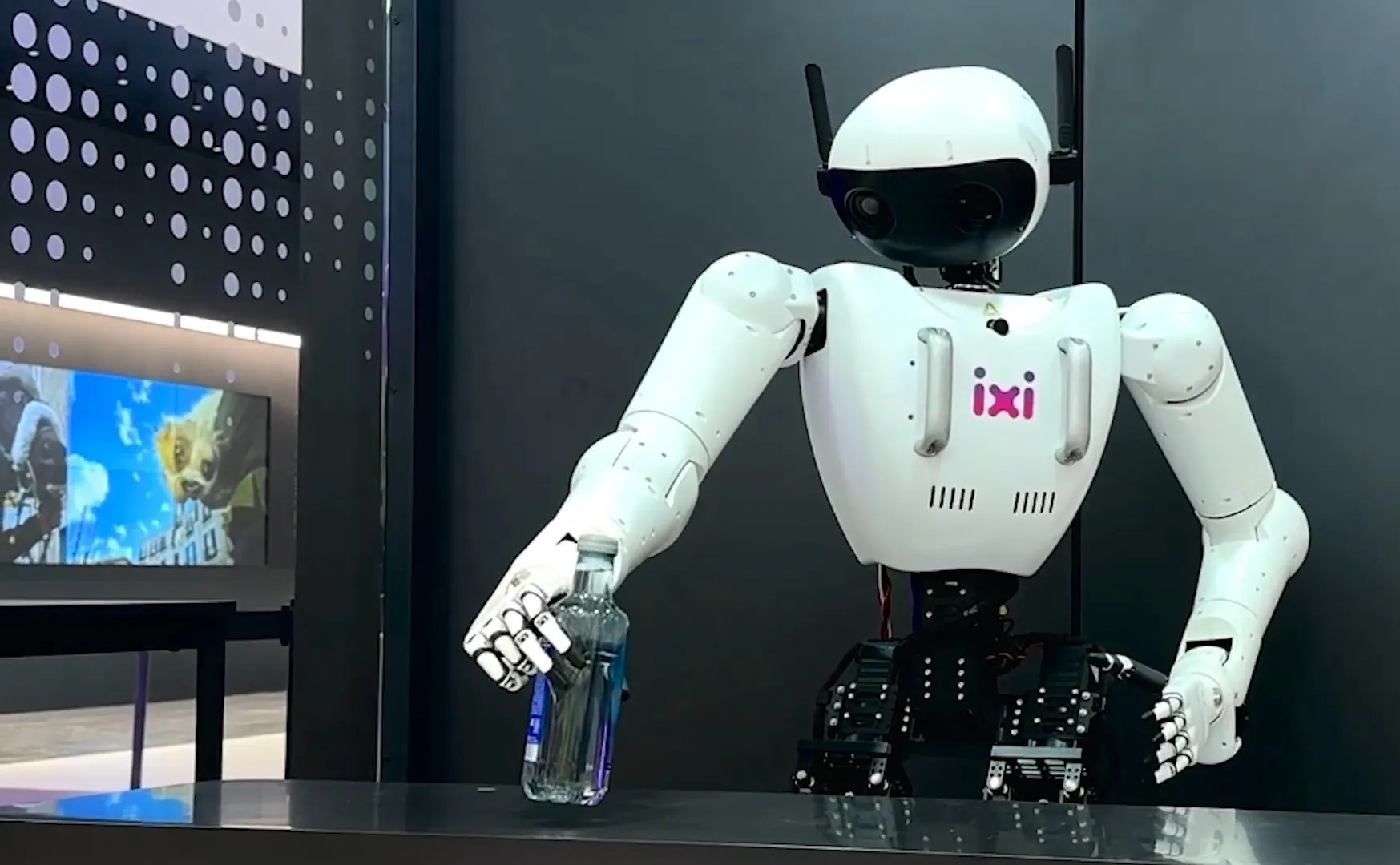
AeiRobot operates across two product categories. The ALICE series addresses full-body humanoid and semi-humanoid industrial platforms, while AIMY serves commercial and service environments requiring customer-facing autonomous interaction. In October 2025, AeiRobot unveiled ALICE M1 in partnership with Advantech, a wheeled semi-humanoid mobile platform designed for logistics and manufacturing line support. At CES 2026, the company demonstrated a collaborative workflow in which ALICE 4 and ALICE M1 operated in tandem on a simulated manufacturing line, with ALICE 4 performing precision manipulation and ALICE M1 handling transport. This dual-robot demonstration was referenced by NVIDIA CEO Jensen Huang in his CES 2026 keynote as an illustrative industrial use case, providing significant third-party validation of AeiRobot's approach. The company has also achieved a notable regulatory milestone as the first humanoid robot company in South Korea to receive government Regulatory Sandbox approval for field demonstrations in manufacturing factories.
Robots
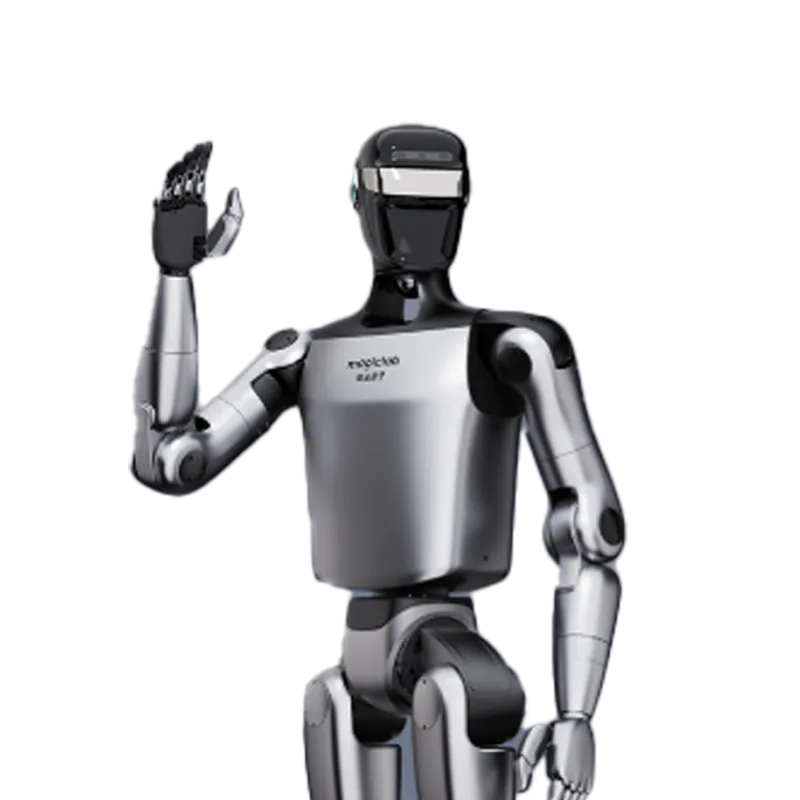
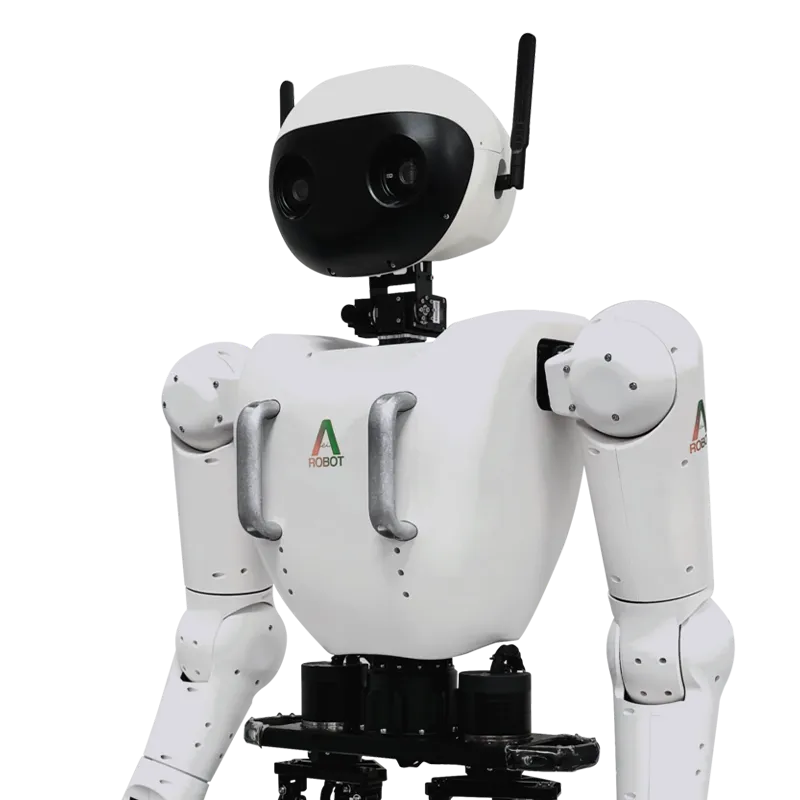
- ALICE 4
A 41-DoF humanoid robot with proprietary gearless actuators delivering precise, quiet force control and stable walking via parallel-leg kinematics. It uses onboard AI for object detection at 30-50 FPS, natural language dialog, and context-aware gestures, and supports VR-based teleoperation for manipulation skill learning. - AIMY
An autonomous humanoid welcome robot standing 1.5 meters tall and weighing 44 kg, equipped with depth, infrared, tracking cameras, and laser sensors. AIMY enables interactive wayfinding, vivid content promotion on display screens, and contextual conversational engagement powered by an AMD Ryzen 5 7600 CPU and NVIDIA RTX 4060 Ti GPU. - EDIE
A companion robot designed for emotional interaction with users, employing AI to provide assistance and social support.
Specialism
- Proprietary gearless actuators for low-friction, precise, and quiet robotic joint control mimicking human muscles.
- Advanced walking control systems combining parallel-leg kinematic design for balance and efficient locomotion.
- Embedded AI for perception and autonomy, including vision-based object detection, natural language processing, and context-aware gesture recognition.
- VR teleoperation and imitation learning loop systems for rapid skill acquisition in manipulation tasks.
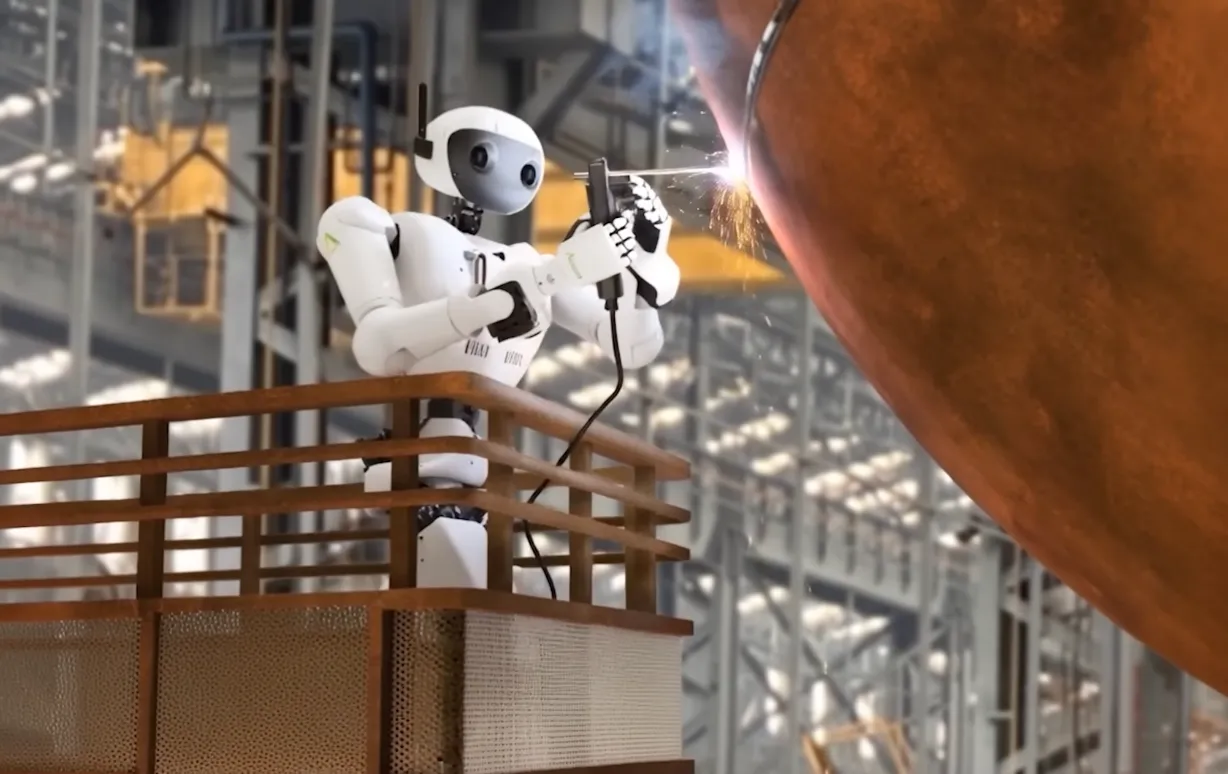
- Robots designed for use in manufacturing, shipbuilding, construction, hospitality, and service environments collaborating closely with humans.
Business Viability
Funding and Financial Position
AeiRobot has raised a total of approximately USD 9.7 million (KRW 13.5 billion) across two rounds as of mid-2025. The initial seed round of USD 2.5 million (KRW 3.5 billion) was raised in 2024, followed by a USD 7.2 million (KRW 10 billion) Series A in July 2025 led by BonAngels Venture Partners, Korea Development Bank (KDB), NH Venture Investment, and Innopolis Partners, with follow-on participation from existing investors Hana Ventures, SGC Partners, and Gauss Capital Management. Total funding remains modest relative to global humanoid peers, reflecting AeiRobot's early stage, but the inclusion of KDB — a South Korean state-owned development bank — signals government-backed confidence in the company's strategic importance.
Revenue Model
AeiRobot's current revenue model is primarily product-based, with robots available for purchase through direct inquiry and enterprise engagement. No publicly stated subscription or RaaS model has been announced. The company's stated objective is to establish humanoids as platforms that "generate actual revenue" in industrial environments, implying a near-term focus on demonstrating measurable operational ROI for manufacturing and logistics clients rather than consumer sales.
Customer and Deployment Base
AeiRobot has received Regulatory Sandbox clearance to conduct field demonstrations at manufacturing, shipbuilding, and construction sites in South Korea. The ALICE humanoid series has been noted as Korea's first to enter shipbuilding and construction site environments. No named commercial customer contracts have been publicly confirmed as of the time of this audit, consistent with the company's pre-revenue demonstration phase.
Strategic Partnerships and Collaborations
AeiRobot's most significant technical partnership is with NVIDIA, with the company identified as an early adopter of the Isaac GR00T humanoid AI platform. This affiliation was publicly recognised at NVIDIA's GTC 2025 InnoVEX event in Taiwan, where AeiRobot won the NVIDIA Award. In October 2025, the company announced a hardware partnership with Advantech to integrate the AFE-R360 Intel Core Ultra embedded compute module into the ALICE M1. AeiRobot participates in the K-Humanoid Alliance, a South Korean government-backed industry consortium of 260 organisations established in April 2025 to coordinate humanoid robot commercialisation and field deployment.
Intellectual Property
AeiRobot's primary IP centres on its proprietary gearless linear actuator design, now in its third generation, and associated force control and impedance control algorithms. The company manufactures most hardware components in-house, including dedicated motor drivers for real-time FOC. URDF models for ALICE 4 are available for download, indicating an open-development posture for the research community. No patent filings have been publicly cited, though the actuator technology is described as internally developed and differentiated from commercially available alternatives.
Market Position and Competitive Advantage
Within the South Korean humanoid robotics landscape, AeiRobot occupies a distinctive position as an academically rooted hardware-first company with genuine proprietary actuator technology. Its dual-platform strategy, pairing the bipedal ALICE 4 with the wheeled ALICE M1 for collaborative industrial workflows, addresses near-term deployment practicality in a way that pure bipedal humanoid approaches do not. The CES 2026 Jensen Huang keynote citation represents a meaningful credibility signal for a company of this size. Relative to global competitors, AeiRobot is substantially smaller in funding and headcount, but its Regulatory Sandbox approval and K-Humanoid Alliance membership give it access to government-supported deployment pathways that are not available to foreign companies operating in Korea.
Leadership and Team
CEO Yunseol Um (Eum YounSeal) is the founding executive and public face of the company, and holds an executive committee seat on the K-Humanoid Alliance. The company originated from the lab of Professor Jaekweon Han at Hanyang University ERICA, and remains physically co-located within the Hanyang University ERICA Business Incubator at its founding address. The team size of 11 to 50 employees reflects an early-stage organisation.
Awards and Recognition
NVIDIA Award and Okinawa Innovation Award at GTC 2025 InnoVEX (Taiwan, May 2025). Referenced by NVIDIA CEO Jensen Huang as an industrial use case demonstration in his CES 2026 keynote address (Las Vegas, January 2026). Featured in the inaugural K-Humanoid Alliance joint exhibition at CES 2026. Korea's first humanoid robot company to receive government Regulatory Sandbox approval for manufacturing field demonstrations.
Risks and Challenges
AeiRobot is at an early commercial stage with total funding of under USD 10 million and a small team, placing it in a structurally vulnerable position relative to well-capitalised global competitors. No confirmed revenue-generating customer deployments have been publicly disclosed. The company's industrial target markets — manufacturing, shipbuilding, and construction — require long sales cycles, extensive safety certification, and significant operational proof before procurement decisions are made at scale. The plan to complete demonstration projects by 2028 and then begin mass production means a meaningful revenue horizon is at least three years away. EU market expansion plans, which include navigating the EU AI Act and new Machinery Regulation compliance, add regulatory complexity and cost to an already constrained resource base.
Expansion and Outlook
AeiRobot's stated near-term roadmap targets demonstration project completion at Korean manufacturing, shipbuilding, and construction sites by 2028, followed by a transition to mass production of affordable humanoids. For international expansion, the company has identified major European manufacturing economies — specifically Germany, the United Kingdom, France, and Italy — as primary export markets, framing its value proposition around addressing labour shortages in automotive and industrial sectors. The company has indicated it will pursue EU AI Act and new Machinery Regulation certification proactively as part of this strategy. Domestically, AeiRobot benefits from favourable tailwinds including South Korea's national K-Humanoid strategy, government-backed funding infrastructure, and a shrinking domestic labour pool that creates structural demand for industrial automation.