


Intro
AI² Robotics (智平方科技) was founded on 17 April 2023 in Shenzhen, China, by Dr. Guo Yandong (Eric Guo), a nationally recognised innovation leader and adjunct professor at the Hong Kong University of Science and Technology (Guangzhou). Guo brings over 15 years of experience at the intersection of AI and intelligent hardware, having led core research and development at Microsoft, OPPO, and Xpeng Motors, where his AI systems have been deployed across hundreds of thousands of intelligent vehicles, hundreds of millions of consumer electronics terminals, robots, and Microsoft's MaaS infrastructure. The company's founding mission is to extend AGI from the digital world into the physical world, building general-purpose humanoid robots that can autonomously handle tasks humans are unwilling or unable to perform safely. AI² Robotics positions itself as an AGI-native company, meaning its hardware and software are co-designed from inception around a foundation model architecture rather than engineering a robot platform and layering AI on top after the fact.
From founding in April 2023 through the end of 2024, AI² Robotics built a foundational technology base around what it describes as one of the earliest consistent commitments to Vision-Language-Action model development in the global robotics startup ecosystem. The company states its end-to-end VLA research was published before the landmark pi-zero paper from Physical Intelligence, and that its model metrics outperformed the SOTA models of that period. In June 2025, it publicly released FiS-VLA, the open-source version of its GOVLA (Global and Omni-body Vision-Language-Action) model, which outperformed the international benchmark pi-zero by 30% in authoritative evaluations, earning acknowledgement and public support from Turing Award laureate Yann LeCun. The proprietary production version of the GOVLA model, AlphaBrain, powers all AlphaBot robots and implements a dual Fast-and-Slow processing architecture for simultaneous real-time motion control and deep task reasoning. By June 2025, AI² Robotics completed seven financing rounds totalling hundreds of millions of yuan in the first half of 2025 alone, with Shenzhen Capital Group as a lead investor. In a September 2025 Reuters interview, CEO Guo confirmed total funding of approximately USD 140 million, unicorn status, and H1 2025 revenue of USD 15 million — a figure dwarfed by a single subsequent contract.
In September 2025, AI² Robotics announced a strategic contract with HKC Corporation, a semiconductor display manufacturer, for over 1,000 AlphaBot 2 robots to be deployed across three years, with CEO Guo estimating the deal's value at approximately USD 70 million. This single contract represents nearly five times the company's H1 2025 total revenue and constitutes one of the largest confirmed humanoid robot procurement agreements ever announced at the time of signing. Prior commercial deployments confirmed by 2025 include semiconductor manufacturing, automotive manufacturing at Dongfeng Liuzhou Motor facilities, biotech environments, and airports in first-tier Chinese cities. In April 2025, AI² Robotics jointly established the Peking University — AI² Robotics Embodied Intelligence Joint Laboratory with Peking University to advance frontier embodied AI research. The company's own production line, established by the end of 2025, carries a rated capacity of 1,000 units per year with plans to scale to 10,000 units per year by 2026. CEO Guo has stated a target of 10x annual revenue growth, and confirmed the company is exploring a public listing within one to two years.
Robots
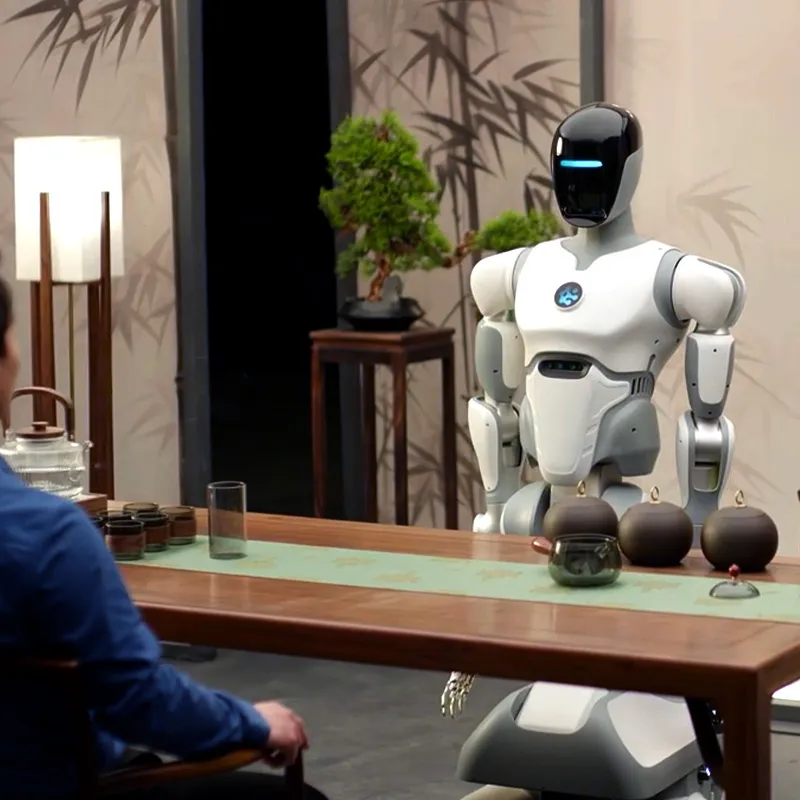
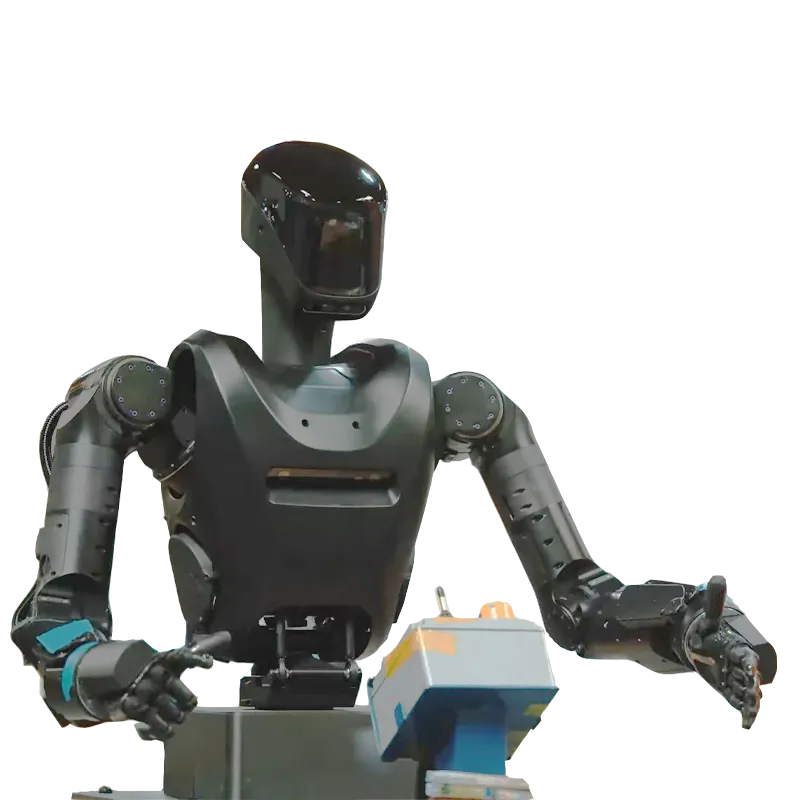
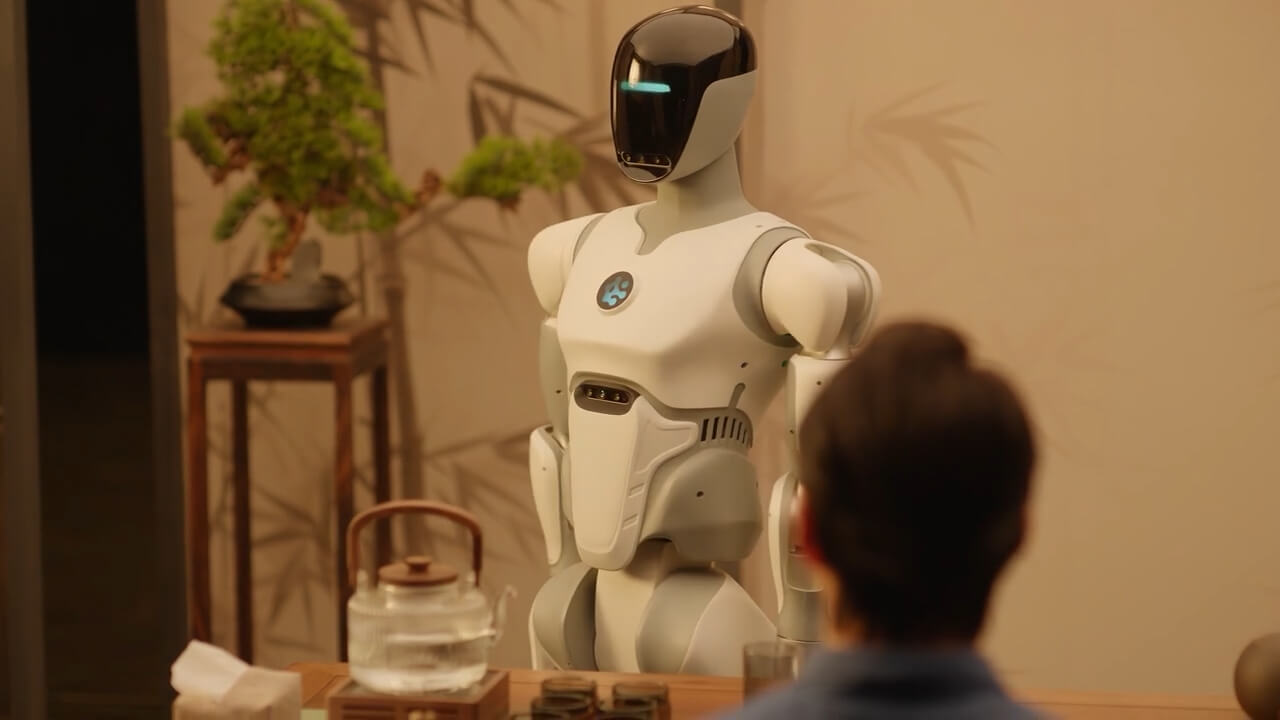
- AlphaBot 2: A general-purpose wheeled humanoid robot with a humanoid upper body on a six-wheeled base, featuring 34 DoF. Powered by AlphaBrain GOVLA.
Specialism
- GOVLA Architecture:
AI² Robotics' primary technical differentiator is the GOVLA model, which processes full-space environmental understanding, whole-body joint coordination, and complex task reasoning through a single unified architecture rather than separately modelled subsystems. The open-source FiS-VLA version outperformed pi-zero by 30% in authoritative benchmarks and was recognised by Turing Award laureate Yann LeCun. - AGI-Native Full-Stack Development:
The company was designed from its founding around a foundation model architecture rather than adapting robotics hardware to accommodate AI post-hoc, resulting in hardware and software co-optimised for the GOVLA inference pipeline. This vertical integration across actuators, sensors, control, and AI is described as enabling superior task generalisation compared to assembled third-party stack approaches. - Dual Fast-and-Slow Processing Architecture:
AlphaBrain's separation of real-time reactive motion control (fast loop) from deep semantic reasoning and task decomposition (slow loop) enables the robot to maintain physical safety and responsiveness while planning and executing multi-step autonomous tasks, a dual-process design that mirrors architectural principles in human cognitive science. - Data Closed-Loop with Scenario Compounding:
AI² Robotics operates its own industrial-grade data platform using what it describes as search-engine-scale big data, trained on a thousand-GPU compute cluster. Each commercial deployment generates operational data that feeds back into the training pipeline, creating a compounding improvement cycle across the fleet over time. - Earliest-to-Market VLA Commitment:
AI² Robotics published end-to-end VLA research earlier than Physical Intelligence (pi-zero), representing one of the first global commercial commitments to end-to-end vision-language-action model development for physical robots. The open-source release of FiS-VLA provides a public benchmark and developer ecosystem entry point that strengthens the company's research credibility.
Business Viability
- Secured hundreds of millions of yuan in funding from top-tier venture capital and strategic investors including Alibaba Group and Lenovo Capital.
- Experienced leadership with founder Guo Yandong’s 15+ years in AI and robotics.
- Rapid product development and commercialization with multiple robot models launched within two years.
- Strategic partnerships with universities and industry players to advance AI research and deployment.
- Targeting high-growth sectors such as smart manufacturing, autonomous logistics, and public service robotics.
- Plans for commercial deployment in airports and residential communities by late 2025.
- Emphasis on full-stack capabilities across hardware, AI, and supply chain control to ensure scalability and production readiness.