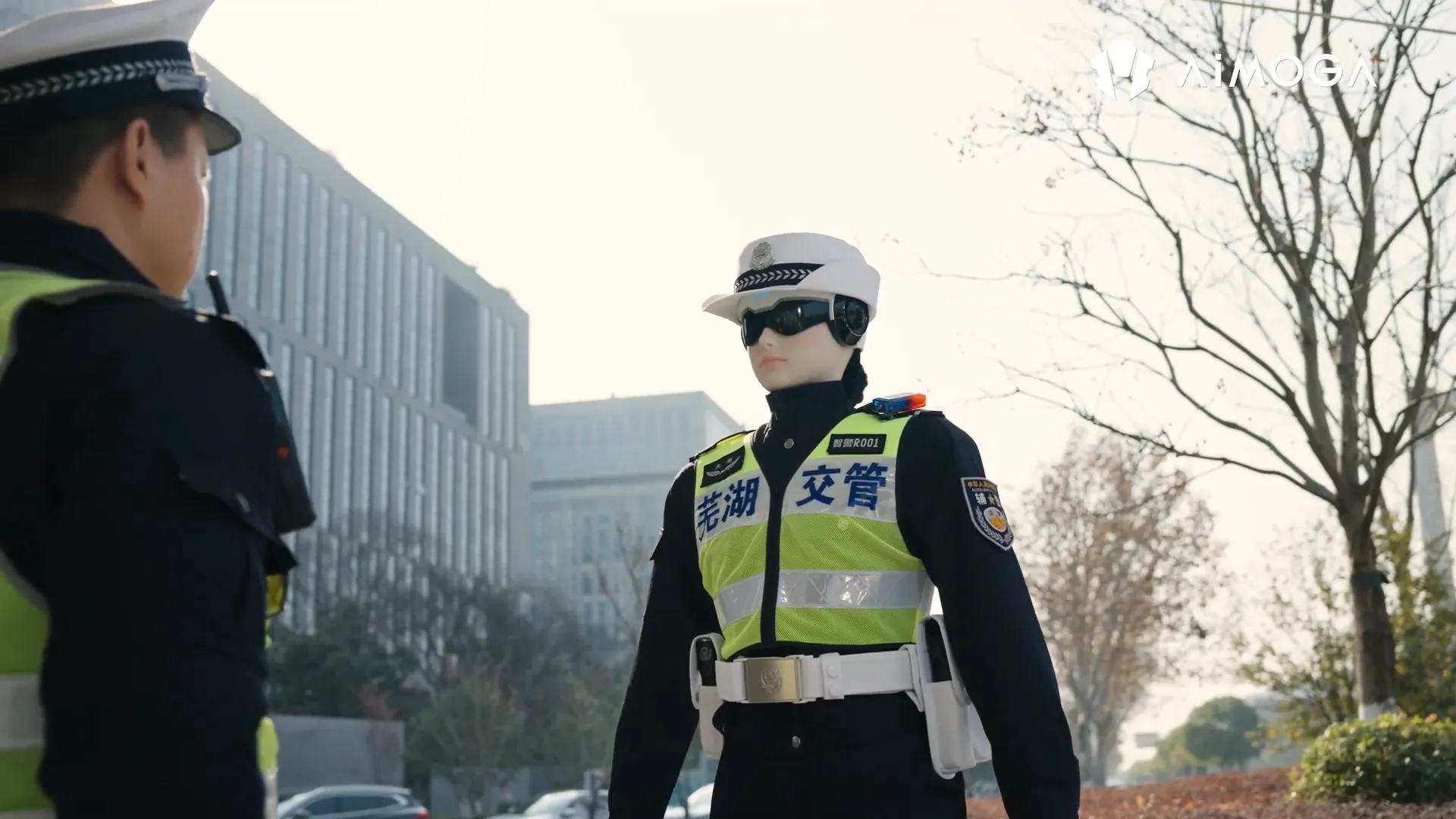
- As of early 2026, the ZhiJing R001 have moved from pilots to routine operations in Wuhu.
- Research confirms the humanoid form creates a "social presence" that acts as a more effective behavioral deterrent than static digital signs.
- By handling repetitive signaling, these robots shield human police from the "three extremes": extreme weather, deafening noise, and toxic exhaust.
- China is rapidly integrating humanoids into daily life, moving beyond the "prototype phase" to establish robots as essential urban infrastructure.
The hustle of a modern city intersection is a chaotic symphony of engines, rushing pedestrians, and the occasional shrill of a whistle. But in cities like Wuhu and Hangzhou, a new conductor has taken the podium. On January 10, 2026, coinciding with the 6th China People's Police Day, AiMOGA Robotics officially deployed its ZhiJing R001 (Intelligent Police Unit) to the frontline of urban traffic management.
Stationed on a traffic island at the busy intersection of Zhongjiang Avenue and Chizhu Mountain Road, the ZhiJing R001 is not just a high-tech ornament. It is a functional, badge-wearing member of the safety force, marking a pivotal shift from lab-based experiments to real-world urban utility.
The Rise of the "ZhiJing R001": Precision in the Chaos
The ZhiJing R001 represents the pinnacle of AiMOGA’s "Wuyou" series of intelligent assistants. Clad in a crisp police-style aesthetic and wearing its official unit badge, the R001 is designed to perform the repetitive, high-visibility signaling that keeps traffic flowing.
Its primary role is "Human-Robot Synergy." While it performs standardized hand signals such as "Stop" and "Go Straight", with a fluidity that mimics human motion, it remains tethered to the city's broader digital brain. Integrated directly with local traffic signal systems, the R001 uses a sophisticated multi-modal perception stack to monitor the road. If it detects a cyclist without a helmet or a car creeping over the stop line, it doesn't just watch; it issues polite, standardized voice prompts to nudge behaviors back toward safety.
The Human Advantage: Shifting Risk to Silicon
The most compelling argument for deploying a ZhiJing R001 isn't about replacing human officers, it’s about protecting them. Traffic intersections are among the most hostile work environments in a city. Officers are daily exposed to:
- The "Three Extremes":
Adverse weather, toxic vehicle exhaust, and deafening noise. - Physical Strain:
Standing on concrete for 8 to 12 hours a day, performing repetitive signaling that leads to long-term joint and muscle issues. - Safety Risks:
The constant danger of being struck by distracted drivers.
By delegating these "high-risk, low-complexity" tasks to a humanoid, police departments can reassign human officers to "high-value" roles. An R001 can manage the flow of a standard Tuesday afternoon, allowing its human partner to focus on investigating accidents, handling complex disputes, or responding to emergencies that require genuine human empathy and judgment.
Why a Humanoid? The Psychology of the Gesture
You might ask: Why deploy a complex, 70kg robot when a digital sign or a camera on a pole could do the job? The answer isn't about the hardware; it’s about Human-Robot Interaction (HRI).
- The Power of Anthropomorphism:
Research from institutions like Halmstad University (2025) and IEEE (2022) confirms that humans are evolutionarily hard-wired to respond to the human form. When a ZhiJing R001 lifts its arm in a "Stop" gesture, it triggers a cognitive response in drivers that is significantly faster than seeing a red light on a screen. - The "Audience Effect":
We behave differently when we feel "watched" by a social entity. Unlike a static camera lens, which feels like an inanimate recorder, a humanoid robot creates a social presence. This creates a psychological "deterrent effect"—pedestrians and drivers are instinctively more compliant with traffic laws when a "body" is physically present and observing them. - Trust and Communication:
In mixed traffic environments, "explicit communication" is key. A humanoid can use gaze, head tilts, and hand signals to acknowledge a pedestrian's intent. This two-way communication builds a level of trust and clarity that a digital sign simply cannot replicate, making the road feel more human and less like a cold machine-governed grid.
China’s Fast-Track to the Smart City Reality
If 2025 was the year of the "humanoid pilot," 2026 is the year of mass integration. China is moving at a pace that few other regions can match, turning sci-fi concepts into daily urban infrastructure.
With over 150 humanoid startups and a supply chain that allows a robot to go from blueprint to the street almost entirely within a 150km radius of cities like Shanghai, the "British Prodigy" now has a formidable global rival.
The achievement here isn't just the technology; it is the normalization. In China’s smart cities, the "social presence" of a robot officer is no longer a novelty, it is a trusted part of the everyday urban pulse.
About the author